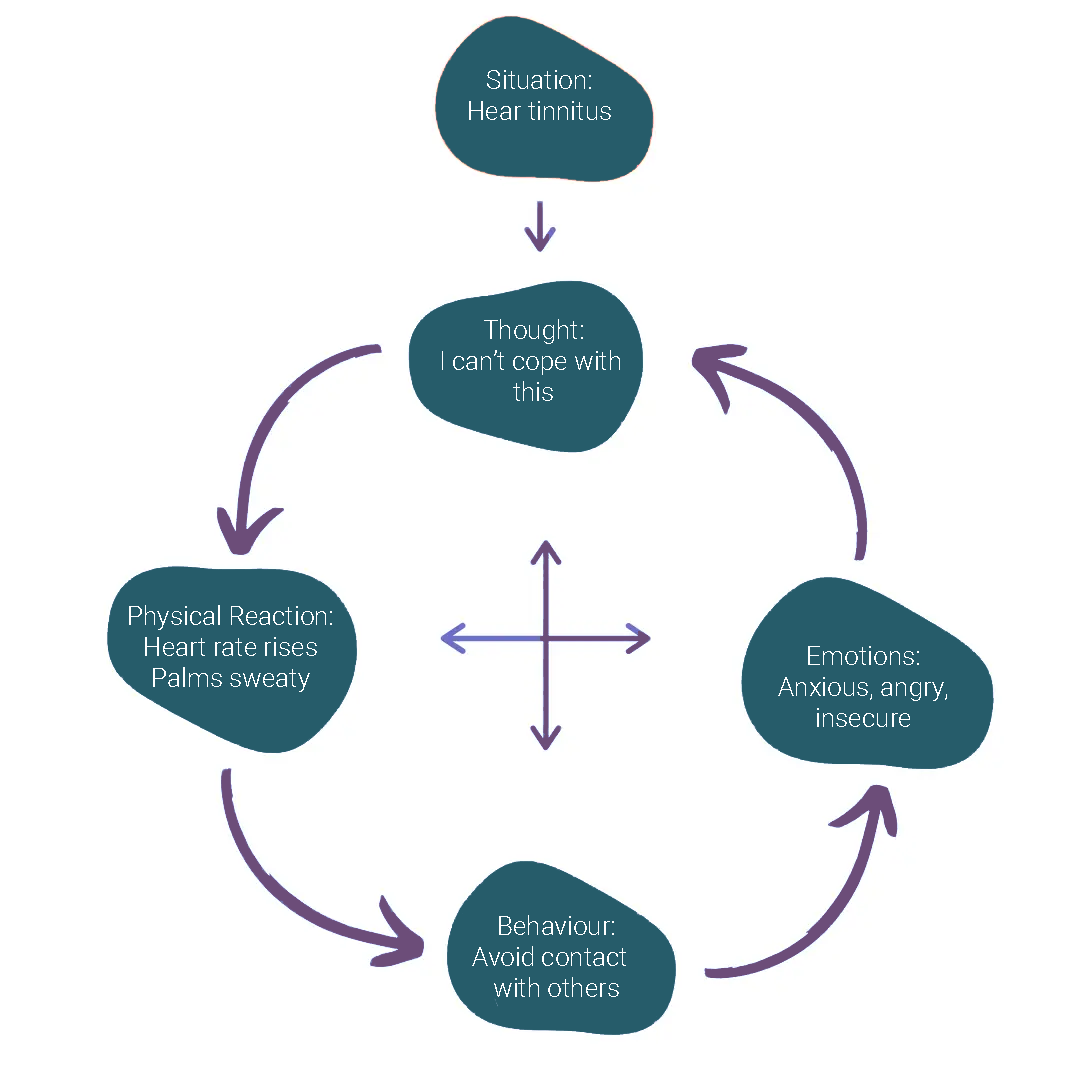
How CBT Works
The theory behind CBT is to teach individuals to challenge and change unhelpful negative thoughts. By reducing negative thoughts, negative emotions should also reduce,
making room for more positive behaviours and better quality of life.
Unfortunately the human brain is wired in such a way that it cannot ignore or habituate to sounds it perceives as dangerous. With the use of CBT and reducing the negative
associations with tinnitus your brain will no longer be on high alert to tinnitus. This process is known as habituation.
To use an example, imagine you are a caveman and you can hear lions roaring in the distance. Your brain will not be able to ignore this sound as it is telling you 'run', 'hide',
'protect yourself'. However, now imagine that lion is in a cage and has no way of harming you. The sound of roaring will no longer be associated with fear, hence after some time
your brain will tune out the lion's sound. This is habituation.
TTT sessions feature techniques commonly used in CBT including; identifying negative thoughts, decreasing avoidance behaviours, gradual exposure, challenging / changing
thoughts and relaxation.